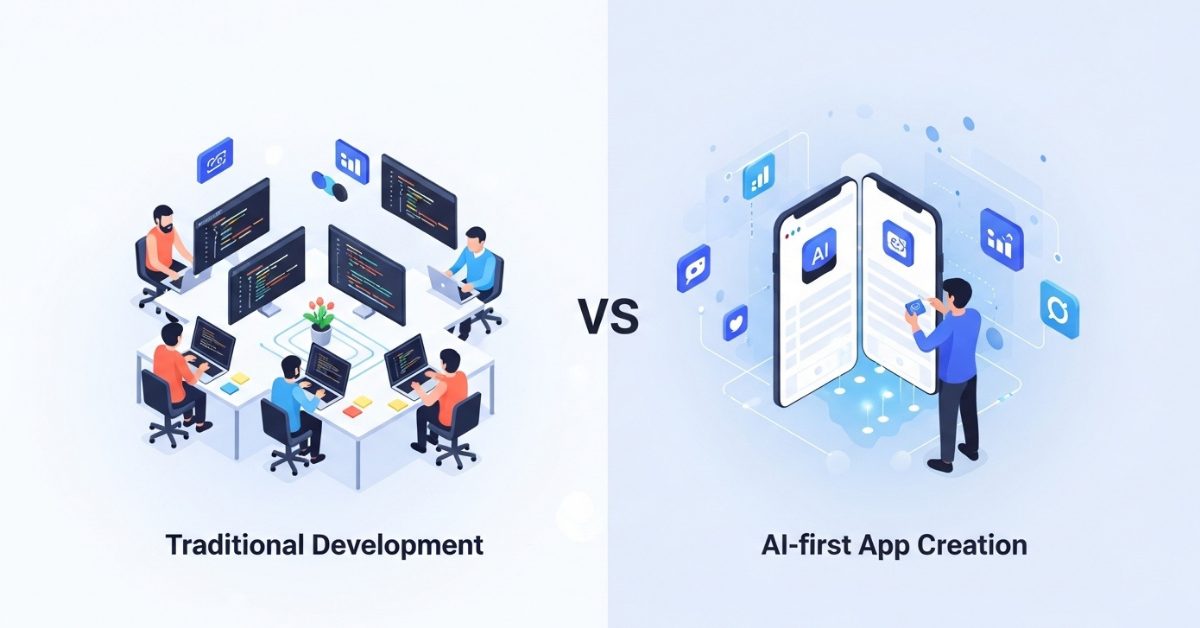
Intro: The Question Every Founder Starts With
“How much does it cost to build an app in 2025?”
It’s the first question every founder, startup team, or investor asks, and one of the hardest to answer truthfully.
The web is full of average cost charts (“$50k–$250k per app!”), but those numbers rarely tell the whole story.
What most founders overlook are the hidden costs, not just money, but time, iteration delays, and opportunity loss.
Let’s break down what app development really costs in 2025 and why modern AI tools are completely rewriting the equation.
1. Traditional App Development: The Cost Breakdown
A traditional mobile or web app involves five moving parts:
- Planning & Research
- Design (UI/UX)
- Development (Frontend + Backend)
- Testing & QA
- Deployment & Maintenance
Each stage has its own price tag; often inflated by handoffs, team overhead, and iteration loops.
| Component | Typical Cost (2025 rates) | Notes |
|---|---|---|
| UI/UX Design | $8,000 – $20,000 | Separate Figma or design agency |
| Development | $50,000 – $120,000 | 3–6 months average build time |
| QA & Testing | $5,000 – $15,000 | Manual + automated |
| Launch & Infrastructure | $2,000 – $10,000 | App store fees, hosting, setup |
| Maintenance (Yearly) | $10,000 – $25,000 | Updates, bug fixes, API changes |
Even for a simple MVP, you’re easily looking at $60,000+ and 3–6 months before you can show something real.
And that’s before updates, scaling, or marketing costs enter the picture.
2. The Hidden Costs Founders Rarely Budget For
The biggest expense in app building is not what you see upfront; it’s what sneaks in afterward.
🔁 Updates and OS Changes
Apple and Google roll out major updates yearly. Each one can break dependencies, libraries, and UIs — forcing you to pay devs again to “just fix it.”
📈 Scaling
Your MVP works fine with 100 users, but at 10,000? You’ll need new servers, new architecture, and a DevOps retainer.
👥 Team Turnover
Freelancers move on. Agencies get busy. Internal devs get poached. Continuity loss means relearning your own codebase — on your dime.
⏳ Opportunity Cost
Every week spent waiting on design iterations or dev handoffs is a week your idea isn’t live.
If your competitor ships faster, you pay in lost traction, not just dollars.
In short, founders don’t just underestimate what they’ll spend, they underestimate what delays will cost them.
If you’re curious to know how some startups accelerate MVPs using AI-first tools, here’s how they do it → How Startups Build MVPs Faster with AI.
3. Modern Alternatives: AI Builders Change the Equation
Here’s the reality shift:
In 2025, you no longer need a full dev team to bring your idea to life.
AI-first app builders like AppForceStudio now handle design, prototyping, and even production-level code generation without traditional overheads.
Here’s what this new model looks like (based on [AppForceStudio’s Cost Calculator Tool]):
| Category | Traditional Dev | AI-first Platform |
|---|---|---|
| Estimated Cost | $116,000+ | From $0 – $20/month |
| Time to Launch | 3–6 months | ~2 weeks |
| Team Needed | 6–10 people | Just you (or small team) |
| Design Process | Hire designers | Use ready templates or AI prompt |
| Iteration Speed | Slow (dev cycles) | Instant changes |
| Ongoing Maintenance | Contracted | Built into plan |
Instead of hiring designers, devs, and testers separately, AI-first platforms integrate all three layers:
- AI Prompts → Functional App Code
- Design-to-Screenshot Conversion
- Drag-and-Drop Canvas + Real-Time Preview
- Native iOS/Android Export
In short, what used to take a small army can now be done by one founder over a weekend.
To see how to build an app step-by-step with or without code, check out our guide How to Build an App in 2025.
And if you prefer a hybrid workflow where you can add your own code or modify what AI generates, check out our tutorial on how to convert code to app using a no-code builder.
4. How to Budget Realistically in 2025
Whether you go traditional or AI-first, you still need a plan.
Here’s how to think about budgeting wisely:
🧮 Step 1: Define Your Core Value
You don’t need every feature at launch. Prioritize what proves your concept and helps you learn the fastest.
→ Example: Skip in-app chat until your first 100 users ask for it.
⏰ Step 2: Estimate Time-to-Value
Your runway isn’t just money, it’s momentum.
If your MVP takes 6 months, you’ll burn through validation time before traction starts.
⚙️ Step 3: Include Post-Launch Costs
Set aside 15–25% of your budget for updates, marketing, and analytics setup.
Apps aren’t one-time projects; they’re ongoing systems.
🤖 Step 4: Explore AI-first Tools Early
Even if you plan to scale traditionally later, using AI tools for your MVP can save up to 90% of your initial spend and get you to market faster.
You can even use tools like AppForceStudio’s free App Cost Calculator to simulate both paths — traditional vs AI-first — and see where the time and money really go.
Conclusion: Build Smart, Not Just Fast
In 2025, “How much does it cost to build an app?” isn’t a one-line answer; it’s a mindset shift.
Traditional routes still have their place, but for startups and founders who value speed, learning, and flexibility, AI-first creation is rewriting the rules.
You no longer have to choose between quality and cost efficiency.
You can build real, deployable apps (not just prototypes) without incurring the heavy costs.
The gap between idea and launch is smaller than you think
Traditional development makes building an app feel expensive and out of reach but it doesn’t have to be.
With AppForceStudio, you can go from concept to live product in days, not months, with AI doing the heavy lifting.
Start building smarter. Make this week your launch week.