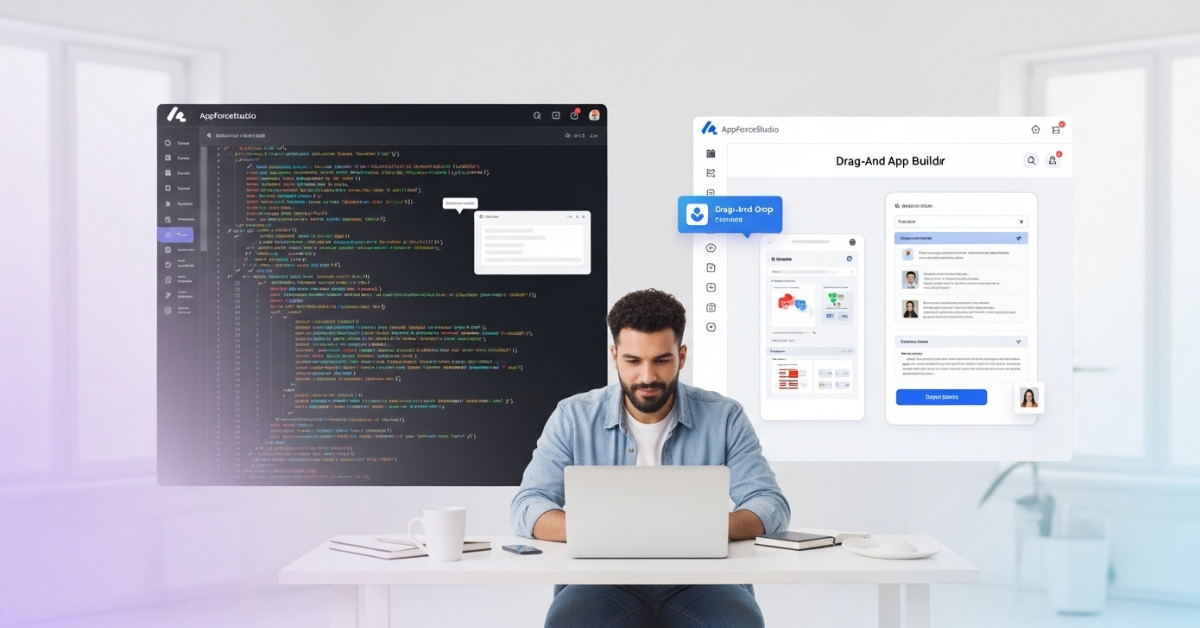
At its core, no-code development abstracts the complexities of programming languages and syntax. Instead of writing lines of code, users interact with intuitive visual environments to design and deploy applications. So really, what is No-Code development?
While the term “no-code” suggests an absence of code, it’s essential to understand that coding still exists behind the scenes. The platforms themselves are built with code; however, they encapsulate this complexity, presenting users with simplified interfaces that handle the underlying logic and operations
This paradigm shift empowers “citizen developers”-business professionals without formal coding experience-to create functional software solutions tailored to their specific needs.
How No-Code Development Platforms Work
No-code platforms provide a suite of tools that facilitate the development process
- Visual Builders: Design user interfaces by dragging and dropping elements onto a canvas.
- Pre-Built Templates: Utilize existing templates for common application types, accelerating the development timeline.
- Workflow Automation: Define business logic and automate processes through visual workflows.
- Data Integration: Connect to various data sources, such as spreadsheets or databases, to manage and manipulate data within the application.
These features collectively reduce the reliance on traditional development cycles, enabling faster prototyping and deployment .
Here is a link to our top no-code tools in 2025: Click here!
Who Uses No-Code?
No-code platforms cater to a diverse audience:
- Entrepreneurs and Startups: Quickly validate ideas and bring products to market without significant upfront investment in development resources.
- Business Analysts and Managers: Develop internal tools and dashboards to streamline operations and enhance decision-making.
- Educators and Students: Create educational applications or projects as part of learning initiatives.
- Non-Profit Organizations: Build applications to support community initiatives without allocating substantial budgets to software development.
By lowering the technical barriers, no-code platforms empower individuals across various sectors to participate in digital transformation efforts.
No-Code vs. Low-Code: Understanding the Difference
While both no-code and low-code platforms aim to simplify application development, they differ in their approach and target users:
- No-Code: Designed for users with little to no programming experience. These platforms offer fully visual interfaces, eliminating the need to write any code.
- Low-Code: Targeted towards users with some coding knowledge. While they provide visual development tools, they also allow for custom code to handle more complex functionalities
The choice between the two depends on the specific requirements of the project and the technical proficiency of the users involved.
Benefits of No-Code Development
- Accelerated Development: Rapidly build and deploy applications, reducing time-to-market.
- Cost Efficiency: Minimize development costs by reducing the need for specialized programming resources.
- Empowerment: Enable non-technical users to contribute to application development, fostering innovation.
- Flexibility: Easily iterate and adapt applications in response to changing business needs.
- Collaboration: Facilitate cross-functional collaboration by involving diverse teams in the development process.
Limitations and Considerations
While no-code platforms offer numerous advantages, it’s important to be aware of potential limitations:
- Scalability: Some platforms may not handle large-scale applications effectively.
- Customization: Highly specialized functionalities might be challenging to implement without traditional coding.
- Vendor Lock-In: Dependence on a specific platform could pose challenges if migrating to another system in the future.
- Security: Ensuring robust security measures requires careful evaluation of the platform’s capabilities.
Assessing these factors is crucial when determining the suitability of a no-code platform for a particular project.
The Future of No-Code Development
The no-code movement is poised to continue its growth trajectory, driven by the increasing demand for rapid and accessible software development solutions. As platforms evolve, we can anticipate enhanced features, greater integration capabilities, and broader adoption across industries.
By empowering a wider range of individuals to participate in application development, no-code platforms are reshaping the digital landscape, fostering innovation, and enabling organizations to respond more swiftly to emerging opportunities and challenges.
Resources: What is no-code development (video)